Open any property news story about a government land sale and you will meet an odd-looking abbreviation: psf ppr. It appears in headlines, analyst quotes and developer announcements. Yet many buyers skim past it. Learning what it means takes five minutes and gives you a sharper lens on every new project you consider.
Breaking Down the Term
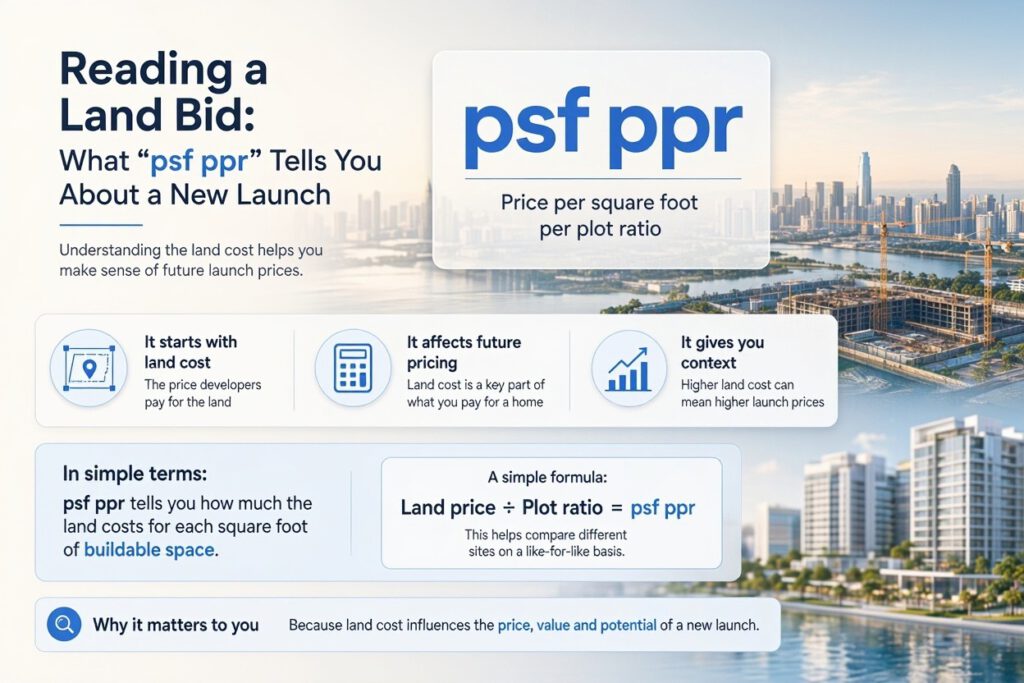
The phrase stands for “per square foot per plot ratio.” It is the price a developer pays for land, expressed per square foot of the floor area it is allowed to build.
Here is why that matters. A plot of land is not valued by its size alone. What counts is how much building you can put on it. Plot ratio is the rule that sets this limit. Multiply the site area by the plot ratio and you get the maximum gross floor area. Dividing the total land price by that floor area produces the psf ppr figure, which lets you compare sites of very different sizes on equal terms.
A Quick Worked Example
Imagine a site of 100,000 square feet with a plot ratio of 2.0. The maximum floor area is 200,000 square feet. If the developer pays S200million,thelandrateisS1,000 psf ppr. Change the plot ratio to 3.0 on the same site and the same price, and the rate drops to roughly S$667 psf ppr. The land itself has not changed, yet the building potential has, and so has the real cost per buildable foot.
Why Buyers Should Care
Land is typically one of the largest costs in a development. A higher land rate generally means the developer must charge more per square foot to protect its margin, once construction, financing and marketing are added. A lower rate gives more room to manoeuvre.
That said, land price is only one input. Construction costs, site conditions, project size, design, market sentiment at launch and the developer’s own strategy all shape the final selling price. Treat the bid as context, not as a forecast.
What the Bid Spread Reveals
When a tender closes, the gap between the top bid and the runners-up is often discussed. A narrow gap suggests that several developers see similar value. A wide gap can mean the winner is more optimistic, or has a different plan for the site. Neither reading is certain, since each bidder has its own costs and appetite.
Two Northern Sites as Case Studies
Recent northern tenders show the concept at work.
The private mixed-use site behind Chencharu Central Residences in Yishun was reported to have been won at about S1.012billion,orroughlyS980 psf ppr. According to the project website, the top bid was around 19.8% above the second-highest of three bids. The site’s plot ratio of about 3.26 supports up to roughly 875 homes, alongside a hawker centre, a bus interchange and commercial space. Those public components affect how the land should be read, so a raw comparison with a purely residential site would be incomplete.
On the other side of the spectrum, the executive condominium site at Sembawang Road, marketed as Fablewoode Residences, was reported as awarded at roughly S197.8million,oraboutS692 psf ppr, from four bids. Its gross plot ratio is just 1.4, which points to a low-rise, lower-density scheme of roughly 265 homes. Remember, too, that ECs are priced under different rules from private condos, so land rates between the two types are not directly comparable. Official names, prices and launch dates for both projects are still to be announced.
Common Mistakes When Using psf ppr
- Comparing across property types. ECs, private condos and mixed-use sites each carry different conditions.
- Ignoring plot ratio differences. The same land price can look cheap or expensive depending on buildable area.
- Treating it as the selling price. Buyers pay a price per square foot of strata area, which differs from land rate.
- Forgetting timing. A bid from a year ago reflects conditions at that time, not necessarily today’s costs.
- Relying on a single analyst. Estimates vary, so read more than one view.
How to Use the Figure Wisely
Use psf ppr as a starting point for questions. How does this site compare with recent tenders nearby? What is unusual about the plot, such as slopes, height limits or public facilities? What might the developer need to charge, and does that fit your budget? Then verify with official documents once the price list is released.
The Takeaway
Psf ppr turns a headline figure into something comparable. It will not tell you what a unit will cost or whether it will rise in value, but it does show how much the developer paid for each buildable foot. Pair it with location, design and your own finances, and you will read new-launch news with far more confidence.